 English
 Español
  Português
  русский
  Français
  日本語
日本語  Deutsch
  tiếng Việt
  Italiano
  Nederlands
  ภาษาไทย
  Polski
  한국어
한국어  Svenska
  magyar
  Malay
Malay  বাংলা ভাষার
  Dansk
Dansk  Suomi
Suomi  हिन्दी
  Pilipino
  Türkçe
  Gaeilge
  العربية
  Indonesia
  Norsk
Norsk  تمل
تمل  český
český  ελληνικά
  український
  Javanese
  فارسی
فارسی  தமிழ்
தமிழ்  తెలుగు
  नेपाली
  Burmese
  български
  ລາວ
ລາວ  Latine
  Қазақша
  Euskal
  Azərbaycan
  Slovenský jazyk
  Македонски
  Lietuvos
  Eesti Keel
  Română
  Slovenski
  मराठी
मराठी  Srpski језик


How Do T Beam Welding Lines Improve Structural Steel Production Efficiency?
Modern steel fabrication plants face increasing pressure to improve welding precision, production speed, and labor efficiency while maintaining consistent product quality. T Beam Welding Lines have become a critical solution for manufacturers producing steel structures for bridges, shipbuilding, warehouses, heavy machinery, and industrial construction projects. This article explains how these automated systems work, their core advantages, major components, common challenges they solve, and how businesses can choose the right production line for long-term growth.
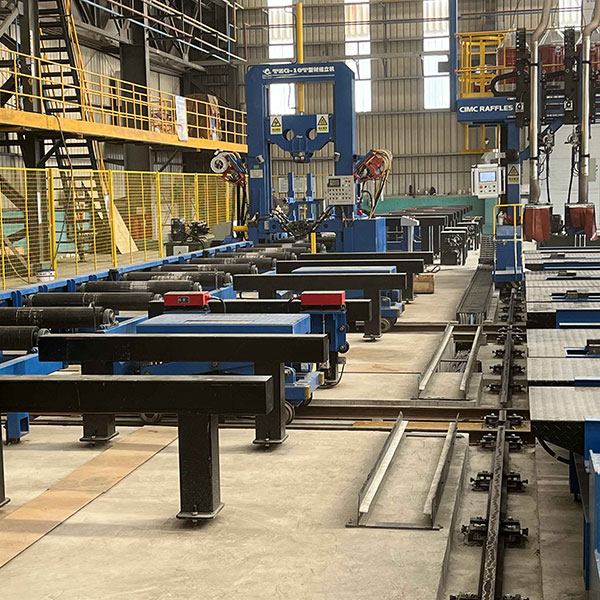
Table of Contents
- What Are T Beam Welding Lines?
- How Does a T Beam Welding Line Work?
- Key Benefits of Automated T Beam Welding Systems
- Main Components of a T Beam Welding Line
- Industries That Use T Beam Welding Lines
- Common Customer Pain Points and Solutions
- How to Choose the Right T Beam Welding Line
- Maintenance Tips for Long-Term Performance
- Frequently Asked Questions
- Conclusion
What Are T Beam Welding Lines?
T Beam Welding Lines are automated or semi-automated production systems designed for manufacturing T-shaped steel beams through precise assembly and welding processes. These production lines integrate several machines and operations into one continuous workflow, allowing manufacturers to improve productivity and reduce manual labor requirements.
In traditional fabrication environments, workers manually position steel plates and perform repetitive welding tasks. This process often causes inconsistent weld quality, low production speed, and higher operational costs. Automated T Beam Welding Lines solve these problems by combining positioning systems, hydraulic clamping devices, conveyor systems, and submerged arc welding technology into a coordinated manufacturing solution.
These systems are widely used in heavy steel structure fabrication because T beams provide excellent load-bearing strength and structural stability.
Key Objective: Improve welding consistency, increase production speed, reduce labor dependency, and lower long-term manufacturing costs.
How Does a T Beam Welding Line Work?
A T Beam Welding Line operates through a sequence of coordinated production stages. Each stage is designed to maintain alignment accuracy and ensure stable welding performance.
- Material Feeding: Steel plates and web components are loaded onto conveyors or positioning stations.
- Automatic Alignment: Hydraulic or mechanical alignment devices position the plates into a precise T-shape.
- Spot Welding: Initial tack welding secures the structure before full welding.
- Main Welding Process: Submerged arc welding machines complete continuous weld seams with high penetration and stability.
- Straightening: Heat distortion correction systems restore beam straightness after welding.
- Inspection and Output: Final inspection ensures dimensional accuracy and weld integrity.
Automation significantly reduces human error while maintaining consistent welding parameters throughout production.
| Production Stage | Main Function | Efficiency Benefit |
|---|---|---|
| Material Feeding | Transfers steel materials automatically | Reduces manual handling |
| Alignment System | Positions plates accurately | Improves dimensional precision |
| Submerged Arc Welding | Performs continuous welding | Enhances weld consistency |
| Straightening Machine | Corrects deformation | Improves final beam quality |
Key Benefits of Automated T Beam Welding Systems
Many manufacturers invest in T Beam Welding Lines to overcome operational bottlenecks and remain competitive in demanding industrial markets.
- Higher Productivity: Automated production lines can operate continuously with minimal interruption.
- Stable Weld Quality: Consistent welding parameters reduce defects and rework.
- Reduced Labor Costs: Fewer operators are required compared to manual welding methods.
- Improved Safety: Automation minimizes worker exposure to high-temperature welding environments.
- Better Material Utilization: Accurate positioning reduces material waste.
- Scalability: Production capacity can be expanded more easily for large projects.
For companies handling large steel structure contracts, these benefits directly impact profitability and project delivery schedules.
Factories upgrading from manual welding processes often report significant improvements in production consistency and reduced downtime after implementing automated T Beam Welding Lines.
Main Components of a T Beam Welding Line
Understanding the structure of a welding line helps buyers evaluate machine quality and system reliability.
| Component | Purpose |
|---|---|
| Hydraulic Alignment Device | Ensures accurate beam positioning |
| Conveyor System | Transfers materials efficiently |
| Submerged Arc Welder | Performs deep penetration welding |
| Straightening Machine | Corrects heat distortion |
| Control System | Manages automation and monitoring |
High-quality systems use durable steel frames, reliable electrical components, and advanced control software to ensure long service life under heavy industrial workloads.
Industries That Use T Beam Welding Lines
T Beam Welding Lines are essential in multiple heavy manufacturing sectors.
- Steel structure fabrication
- Bridge construction
- Shipbuilding and offshore engineering
- Industrial plant construction
- Heavy equipment manufacturing
- Warehouse and logistics center development
- Energy and infrastructure projects
As global demand for steel structures increases, automated welding systems continue to play a critical role in improving production efficiency and structural reliability.
Common Customer Pain Points and Solutions
Many steel fabricators encounter operational challenges before upgrading to automated welding systems.
| Customer Pain Point | How T Beam Welding Lines Solve It |
|---|---|
| Inconsistent weld quality | Automated welding parameters improve uniformity |
| High labor costs | Reduced dependence on manual welding operators |
| Slow production speed | Continuous automated operation increases throughput |
| Material waste | Precise positioning minimizes errors |
| Frequent rework | Stable welding quality reduces defects |
Companies investing in modern automation technology gain better control over production quality while improving operational efficiency.
How to Choose the Right T Beam Welding Line
Selecting the appropriate system depends on production goals, beam specifications, and factory capacity requirements.
When evaluating suppliers, buyers should consider the following factors:
- Maximum beam size compatibility
- Automation level
- Welding speed and power stability
- Machine durability
- Ease of maintenance
- After-sales technical support
- Customization capabilities
- Energy consumption efficiency
A reliable manufacturer should provide installation guidance, operator training, and long-term technical support to ensure smooth production operations.
Before purchasing a production line, factories should carefully analyze their daily output targets, material thickness range, workshop layout, and future expansion plans.
Maintenance Tips for Long-Term Performance
Proper maintenance is essential for maximizing equipment lifespan and preventing costly downtime.
- Inspect welding heads regularly for wear.
- Lubricate conveyor and hydraulic components on schedule.
- Check electrical systems and control panels periodically.
- Clean welding flux recovery systems frequently.
- Monitor alignment accuracy to maintain beam quality.
- Train operators to identify abnormal machine behavior early.
Preventive maintenance reduces unexpected failures and helps maintain stable production efficiency over time.
Frequently Asked Questions
What materials can T Beam Welding Lines process?
These systems primarily process carbon steel and structural steel plates used in heavy fabrication industries.
Are T Beam Welding Lines fully automated?
Many systems are highly automated, although some factories choose semi-automatic configurations depending on production requirements and budget.
How does submerged arc welding improve quality?
Submerged arc welding provides deep penetration, stable arc performance, and reduced spatter, resulting in cleaner and stronger weld seams.
Can the production line be customized?
Yes. Many manufacturers offer customized solutions based on beam dimensions, factory layout, and production capacity needs.
How important is after-sales service?
Strong technical support is critical because installation, calibration, maintenance, and operator training directly affect long-term production stability.
Conclusion
T Beam Welding Lines are transforming the steel fabrication industry by improving production efficiency, welding consistency, and operational reliability. As construction and infrastructure projects continue expanding worldwide, manufacturers need advanced automation systems capable of meeting strict quality and delivery requirements.
Choosing a dependable equipment supplier is equally important as selecting the right production line configuration. JINFENG provides professional T Beam Welding Line solutions designed for modern steel fabrication environments, helping manufacturers improve productivity while reducing operational costs.
Contact JINFENG for Professional Welding Solutions
If you are looking for reliable and efficient T Beam Welding Lines for your steel structure production projects, JINFENG can provide customized solutions tailored to your manufacturing requirements.
Send Inquiry



X
We use cookies to offer you a better browsing experience, analyze site traffic and personalize content. By using this site, you agree to our use of cookies.
Privacy Policy