

Abstract
T Beam Welding Lines are specialized automated production systems designed to manufacture T-shaped beams with high precision, consistency, and speed. This article explores how these systems address key challenges in steel structure fabrication, including labor inefficiency, inconsistent weld quality, and production bottlenecks. It also highlights core components, workflow optimization, technical specifications, and real-world applications. Whether for shipbuilding, construction, or heavy machinery manufacturing, T Beam Welding Lines provide a scalable solution that significantly improves productivity and weld integrity.
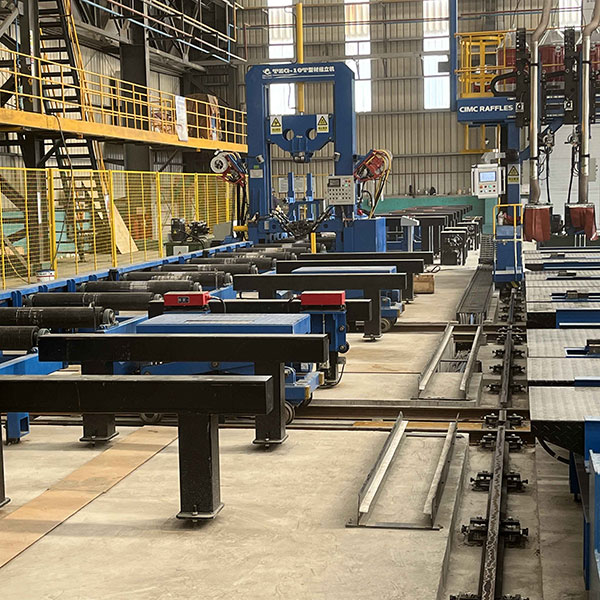
Table of Contents
- 1. Introduction to T Beam Welding Challenges
- 2. What Are T Beam Welding Lines
- 3. Core Components of the System
- 4. Production Workflow Explained
- 5. Key Benefits and Efficiency Gains
- 6. Industry Pain Points Solved
- 7. Technical Specifications Overview
- 8. Maintenance and Best Practices
- 9. Industrial Applications
- 10. Why Choose JINFENG Solutions
- 11. Frequently Asked Questions
- 12. Conclusion
1. Introduction to T Beam Welding Challenges
In modern steel fabrication industries, T beams are essential structural components used in bridges, buildings, ship hulls, and industrial frameworks. However, traditional welding methods often suffer from low efficiency, inconsistent weld penetration, and high labor dependency. These challenges increase production costs and reduce output reliability.
As industries demand higher precision and faster delivery cycles, manufacturers are shifting toward automated solutions such as T Beam Welding Lines to overcome these limitations and improve operational stability.
2. What Are T Beam Welding Lines
A T Beam Welding Line is an integrated production system that automatically assembles, aligns, welds, and straightens T-shaped steel beams. It combines multiple processes into a continuous workflow, minimizing manual intervention and maximizing production consistency.
Unlike conventional welding setups, these lines are engineered for mass production, ensuring each beam maintains strict dimensional accuracy and structural strength.
3. Core Components of the System
A typical T Beam Welding Line consists of several interconnected modules working in synchronization:
- Web and flange alignment system
- Hydraulic clamping units
- Automatic submerged arc welding machines
- Conveyor feeding and output systems
- Straightening and correction units
- PLC-based control system
Each component plays a critical role in ensuring seamless production flow and maintaining welding accuracy throughout the process.
4. Production Workflow Explained
The operation of a T Beam Welding Line follows a structured sequence designed for efficiency:
- Material loading and positioning
- Automatic alignment of web and flange plates
- Clamping and pre-fixing
- Continuous welding using submerged arc technology
- Cooling and straightening
- Final output and stacking
This streamlined workflow eliminates repeated manual handling and ensures uniform weld quality across large production batches.
5. Key Benefits and Efficiency Gains
Implementing a T Beam Welding Line provides significant operational improvements:
| Aspect | Improvement |
|---|---|
| Production Speed | Increases output by 2–5 times compared to manual welding |
| Weld Quality | Consistent penetration and reduced defect rates |
| Labor Requirement | Reduced dependency on skilled welders |
| Material Waste | Optimized usage with precise alignment systems |
These improvements make the system highly valuable for manufacturers seeking scalable production solutions.
6. Industry Pain Points Solved
Traditional fabrication processes often struggle with:
- Uneven weld seams causing structural weaknesses
- High dependency on manual labor
- Slow production cycles
- Inconsistent product dimensions
T Beam Welding Lines address these issues by integrating automation, precision control, and continuous operation into a single system, significantly improving production reliability.
7. Technical Specifications Overview
Below is a general overview of standard configuration parameters:
| Parameter | Specification Range |
|---|---|
| Beam Height Capacity | 200mm – 2000mm |
| Welding Method | Submerged Arc Welding (SAW) |
| Production Speed | 0.5 – 2.5 m/min |
| Control System | PLC Automated Control |
8. Maintenance and Best Practices
To ensure long-term stability and optimal performance, operators should follow these best practices:
- Regular inspection of welding heads and nozzles
- Calibration of alignment systems
- Routine cleaning of conveyor systems
- Monitoring of hydraulic pressure levels
Preventive maintenance significantly reduces downtime and extends equipment lifespan.
9. Industrial Applications
T Beam Welding Lines are widely used in:
- Steel structure construction
- Shipbuilding industry
- Bridge engineering
- Heavy machinery manufacturing
- Energy infrastructure projects
Their versatility makes them an essential asset in any large-scale fabrication environment.
10. Why Choose JINFENG Solutions
When selecting a reliable manufacturing partner, system stability, engineering precision, and after-sales support are critical factors. JINFENG delivers advanced T Beam Welding Line solutions designed for industrial scalability and long-term durability.
With a strong focus on automation integration and structural welding expertise, JINFENG helps manufacturers reduce operational costs while improving output consistency and quality assurance.
To learn more about system configurations and customized solutions, visit JINFENG T Beam Welding Lines or contact our engineering team today. For project consultation and pricing details, contact us at JINFENG and explore how we can support your production goals.
11. Frequently Asked Questions
Q1: What is the main advantage of a T Beam Welding Line?
It significantly increases production speed while ensuring consistent weld quality across all beams.
Q2: Can the system handle different beam sizes?
Yes, modern systems are adjustable and can accommodate a wide range of beam dimensions.
Q3: Is operator training required?
Basic training is required for system operation and maintenance, but automation reduces skill dependency.
Q4: What welding method is commonly used?
Submerged arc welding is most commonly used due to its deep penetration and high efficiency.
12. Conclusion
T Beam Welding Lines represent a major advancement in structural steel fabrication, offering unmatched efficiency, precision, and scalability. By integrating automation into the welding process, manufacturers can overcome traditional production limitations and achieve higher output quality with reduced operational costs.
As industrial demands continue to grow, adopting intelligent welding systems is no longer optional but essential for maintaining competitiveness in the global market.