 English
 Español
  Português
  русский
  Français
  日本語
日本語  Deutsch
  tiếng Việt
  Italiano
  Nederlands
  ภาษาไทย
  Polski
  한국어
한국어  Svenska
  magyar
  Malay
Malay  বাংলা ভাষার
  Dansk
Dansk  Suomi
Suomi  हिन्दी
  Pilipino
  Türkçe
  Gaeilge
  العربية
  Indonesia
  Norsk
Norsk  تمل
تمل  český
český  ελληνικά
  український
  Javanese
  فارسی
فارسی  தமிழ்
தமிழ்  తెలుగు
  नेपाली
  Burmese
  български
  ລາວ
ລາວ  Latine
  Қазақша
  Euskal
  Azərbaycan
  Slovenský jazyk
  Македонски
  Lietuvos
  Eesti Keel
  Română
  Slovenski
  मराठी
मराठी  Srpski језик


How to Optimize T Beam Welding Lines for Efficient Production?
Abstract: T Beam Welding Lines are pivotal in modern steel beam fabrication, enabling high-precision welding of structural components used in construction and infrastructure. This article provides a detailed examination of T Beam Welding Lines, including technical specifications, operational insights, frequently asked questions, and optimization strategies. Readers will gain a comprehensive understanding of how to leverage T Beam Welding Lines for enhanced productivity and quality in industrial applications.
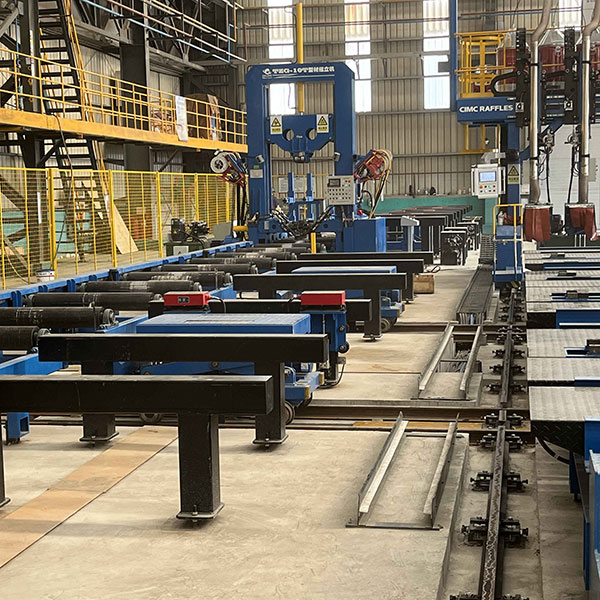
Table of Contents
- 1. Introduction to T Beam Welding Lines
- 2. Technical Specifications and Operational Parameters
- 3. Frequently Asked Questions About T Beam Welding Lines
- 4. How to Optimize T Beam Welding Lines
- 5. Conclusion and Contact
1. Introduction to T Beam Welding Lines
T Beam Welding Lines are industrial systems designed for automated welding of T-shaped steel beams, which are commonly used in bridges, buildings, and heavy machinery structures. These lines integrate cutting-edge welding technology, high-precision positioning systems, and automated feeding mechanisms to ensure consistent quality and high throughput.
The core purpose of T Beam Welding Lines is to achieve high welding efficiency, minimize defects, and reduce manual labor costs in steel beam production. By combining automation with precision engineering, these lines contribute significantly to productivity and structural integrity in construction projects.
2. Technical Specifications and Operational Parameters
The following table summarizes key parameters of a typical T Beam Welding Line:
| Parameter | Specification |
|---|---|
| Beam Size Range | 100mm - 600mm flange width, 100mm - 400mm web height |
| Welding Speed | 0.5 - 1.5 m/min (adjustable) |
| Welding Type | MIG/MAG, submerged arc welding (SAW) |
| Power Supply | AC 380V, 50Hz, three-phase |
| Automation Level | PLC controlled with HMI interface |
| Positioning Accuracy | ±0.5 mm |
| Beam Length Capacity | Up to 20 meters |
| Material Compatibility | Carbon steel, alloy steel |
These specifications reflect the balance between flexibility and precision, making T Beam Welding Lines suitable for diverse industrial applications, including large-scale bridge projects and multi-story building frameworks.
3. Frequently Asked Questions About T Beam Welding Lines
Q1: How can T Beam Welding Lines ensure consistent weld quality?
A1: T Beam Welding Lines achieve consistent weld quality through automated positioning systems, programmable welding parameters, and real-time monitoring of welding current, voltage, and speed. This minimizes human error, ensures uniform penetration, and reduces the likelihood of defects such as porosity or misalignment.
Q2: How is maintenance performed on T Beam Welding Lines?
A2: Maintenance includes routine inspection of welding torches, wire feeding mechanisms, conveyor rollers, and control systems. Regular lubrication, sensor calibration, and software updates are essential. Preventive maintenance schedules are recommended to avoid unscheduled downtime and maintain consistent operational performance.
4. How to Optimize T Beam Welding Lines
Optimizing T Beam Welding Lines involves a combination of technical adjustments, process improvements, and operator training:
4.1 Process Calibration
- Regularly calibrate welding parameters according to beam material and thickness.
- Use automated sensors to monitor seam alignment and penetration depth.
- Implement adaptive welding algorithms to adjust for minor beam size variations.
4.2 Equipment Efficiency
- Schedule periodic preventive maintenance to reduce unexpected downtime.
- Upgrade software controls for faster data processing and improved HMI visualization.
- Ensure the power supply is stable and meets the welding load requirements.
4.3 Material Handling
- Optimize the conveyor and positioning systems to minimize beam movement errors.
- Use automated feeding systems to reduce manual handling and improve cycle time.
- Track material properties and adjust welding parameters accordingly for alloy variations.
4.4 Operator Training and Safety
- Provide comprehensive training on equipment operation, emergency procedures, and parameter adjustment.
- Regularly review welding line performance data to identify skill gaps and operational inefficiencies.
- Implement safety protocols to prevent accidents and ensure consistent production.
5. Conclusion and Contact
T Beam Welding Lines represent a strategic investment for industrial steel fabrication, combining automation, precision, and adaptability. Leveraging these systems effectively can significantly improve production throughput and structural quality. JINFENG WELDCUT provides high-quality T Beam Welding Lines, designed to meet modern industrial demands with reliability and efficiency. For inquiries or detailed consultation, contact us today to explore the best solutions for your production needs.
Send Inquiry



X
We use cookies to offer you a better browsing experience, analyze site traffic and personalize content. By using this site, you agree to our use of cookies.
Privacy Policy