 English
 Español
  Português
  русский
  Français
  日本語
日本語  Deutsch
  tiếng Việt
  Italiano
  Nederlands
  ภาษาไทย
  Polski
  한국어
한국어  Svenska
  magyar
  Malay
Malay  বাংলা ভাষার
  Dansk
Dansk  Suomi
Suomi  हिन्दी
  Pilipino
  Türkçe
  Gaeilge
  العربية
  Indonesia
  Norsk
Norsk  تمل
تمل  český
český  ελληνικά
  український
  Javanese
  فارسی
فارسی  தமிழ்
தமிழ்  తెలుగు
  नेपाली
  Burmese
  български
  ລາວ
ລາວ  Latine
  Қазақша
  Euskal
  Azərbaycan
  Slovenský jazyk
  Македонски
  Lietuvos
  Eesti Keel
  Română
  Slovenski
  मराठी
मराठी  Srpski језик


How Box Column Welding Lines Transform Heavy Steel Fabrication?
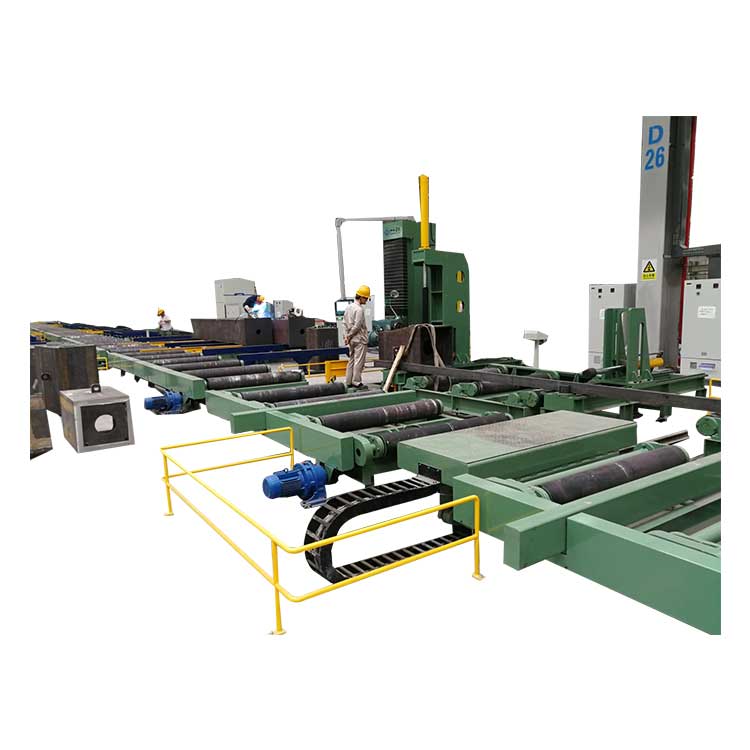
Modern infrastructure, high-rise buildings, bridges, and industrial plants depend heavily on structural steel components that can deliver strength, reliability, and dimensional accuracy. Among these components, box columns are widely used because of their high load-bearing capacity and resistance to torsional stress. Producing these structural members efficiently, however, presents challenges such as maintaining weld quality, ensuring alignment precision, and managing production throughput. This is where advanced Box Column Welding Lines play a critical role. By integrating automation, positioning, and welding processes, manufacturers can significantly reduce labor intensity while improving consistency and output quality. Leading manufacturers like Ningbo JinFeng Welding and Cutting Machinery Manufacture Co., Ltd provide solutions designed to address the operational difficulties faced by fabrication plants and steel structure builders.
Abstract
This article explores the fundamentals, operational principles, benefits, configurations, and selection considerations of box column welding lines used in structural steel fabrication. It examines how integrated systems improve productivity, ensure weld stability, and meet demanding project timelines. Readers will find structured explanations, comparison tables, practical insights, and answers to common buyer questions to support informed decision-making when investing in automated welding lines.
Contents
- Introduction to Box Column Welding Lines
- What Defines a Box Column in Structural Engineering
- Key Components of Welding Lines
- Operational Workflow Explained
- Challenges in Fabrication and Practical Solutions
- Performance Advantages
- Specification Overview
- Manual vs Automated Production Comparison
- Industry Applications
- Selection Considerations
- Maintenance and Optimization
- Future Trends
- FAQ
- Conclusion
Introduction to Box Column Welding Lines
Box column welding lines are integrated production systems designed to assemble and weld steel plates into rectangular or square hollow columns. Instead of performing individual welding operations manually, these lines combine multiple processes such as positioning, tack welding, submerged arc welding, and straightening into a continuous workflow. Companies adopting solutions from Ningbo JinFeng Welding and Cutting Machinery Manufacture Co., Ltd often aim to overcome issues like inconsistent weld seams and slow output rates. With synchronized automation, the fabrication process becomes predictable, scalable, and safer for operators.
What Defines a Box Column in Structural Engineering
A box column is formed by welding together four steel plates into a hollow closed section. The design enhances structural stability while optimizing weight distribution. Engineers select box columns when compressive strength and torsional rigidity are required.
- Used in skyscraper frameworks
- Common in bridge support towers
- Preferred for seismic-resistant structures
- Ideal for heavy industrial construction
Key Components of Welding Lines
Complete systems from Ningbo JinFeng Welding and Cutting Machinery Manufacture Co., Ltd typically include multiple integrated modules that operate as a unified platform.
| Component | Function |
|---|---|
| Assembly Machine | Aligns plates before welding |
| Tack Welding Station | Creates temporary joints |
| Submerged Arc Welding Unit | Performs deep penetration welds |
| Turning Rollers | Rotates column for multi-side welding |
| Straightening Equipment | Corrects deformation |
| Control System | Synchronizes automation |
Operational Workflow Explained
Production begins with plate loading and alignment. Once positioned, tack welding secures the shape before full weld penetration is achieved through automated arc welding. Turning devices rotate the column, ensuring each seam is welded with consistent parameters. Finally, straightening modules restore geometry accuracy before inspection.
- Plate loading and clamping
- Pre-weld alignment checks
- Tack welding sequence
- Multi-pass welding
- Dimensional correction
- Quality verification
Challenges in Fabrication and Practical Solutions
Fabricators frequently encounter distortion, weld inconsistencies, and throughput limitations. Advanced solutions from Ningbo JinFeng Welding and Cutting Machinery Manufacture Co., Ltd address these concerns by incorporating precise motion control, stable heat input management, and automated monitoring.
- Heat deformation reduced through controlled welding parameters
- Alignment maintained via mechanical guidance
- Production delays minimized by continuous operation
- Labor costs optimized through reduced manual handling
Performance Advantages
Implementing a dedicated welding line offers measurable benefits beyond basic productivity gains.
- Uniform weld quality
- Higher throughput capacity
- Improved operator safety
- Consistent structural reliability
- Lower rejection rates
Specification Overview
| Parameter | Typical Range |
|---|---|
| Column Size | 300mm – 1500mm |
| Plate Thickness | 6mm – 80mm |
| Welding Speed | 200–800 mm/min |
| Automation Level | Semi to Fully Automatic |
| Power Requirement | Custom Configuration |
Manual vs Automated Production Comparison
| Factor | Manual Welding | Automated Line |
|---|---|---|
| Consistency | Operator dependent | Highly stable |
| Output | Low | High |
| Safety | Higher risk | Improved protection |
| Cost Efficiency | Labor intensive | Balanced investment |
| Accuracy | Variable | Repeatable |
Industry Applications
These production lines support multiple construction and industrial sectors:
- Urban high-rise projects
- Infrastructure construction
- Shipbuilding yards
- Heavy equipment manufacturing
- Energy facility installation
Selection Considerations
Choosing a welding line requires evaluating production goals, material dimensions, and operational scale. Collaboration with established suppliers such as Ningbo JinFeng Welding and Cutting Machinery Manufacture Co., Ltd ensures configuration alignment with project demands.
- Capacity requirements
- Automation preferences
- Workshop layout compatibility
- After-sales support availability
- Upgrade flexibility
Maintenance and Optimization
Routine calibration, lubrication, and inspection help preserve performance reliability. Monitoring software analytics further assists operators in identifying inefficiencies early, reducing downtime and improving lifecycle value.
Future Trends
Advancements in digital monitoring, robotic welding integration, and data-driven diagnostics will continue reshaping fabrication environments. Manufacturers investing today benefit from scalable infrastructure ready for tomorrow’s industrial expectations.
FAQ
What production scale justifies installing a welding line?
Facilities handling repetitive structural fabrication often benefit from adopting integrated systems due to improved throughput and reduced rework.
Can lines adapt to different column sizes?
Most configurations allow parameter adjustment and modular tooling, supporting a range of dimensions.
Is operator training required?
Yes. Even automated lines require skilled supervision to monitor settings and maintain output quality.
How does automation influence weld quality?
Controlled parameter consistency ensures stable heat input and penetration depth, leading to dependable structural joints.
Why partner with an experienced manufacturer?
Expert guidance ensures system compatibility with production goals and provides reliable technical support throughout operation.
Conclusion
Box column welding lines represent a strategic investment for fabrication enterprises seeking stable production output, precision weld quality, and safer working conditions. By consolidating multiple stages into a unified workflow, manufacturers gain control over efficiency and product reliability. Solutions offered by Ningbo JinFeng Welding and Cutting Machinery Manufacture Co., Ltd provide scalable options for organizations aiming to enhance fabrication capability while maintaining operational stability. If you are exploring advanced structural welding solutions or planning to modernize your production environment, contact us today to discuss how tailored equipment can meet your specific project demands and support your long-term manufacturing growth.
Send Inquiry



X
We use cookies to offer you a better browsing experience, analyze site traffic and personalize content. By using this site, you agree to our use of cookies.
Privacy Policy